Decision making matrix
*For all Lucid plan types
Identify and evaluate ways to accomplish a task by assessing blockers, value, and risk. Make smart choices with the Decision Making Matrix.
About our decision making matrix template
Business decisions can be tough, even if it’s just a binary decision. When there are a variety of options and a whole slew of assessment factors, one decision can quickly grow into a time-consuming, exhausting process.
So how can you avoid decision fatigue while still making informed, effective decisions? Enter a decision making matrix.
What is a decision making matrix?
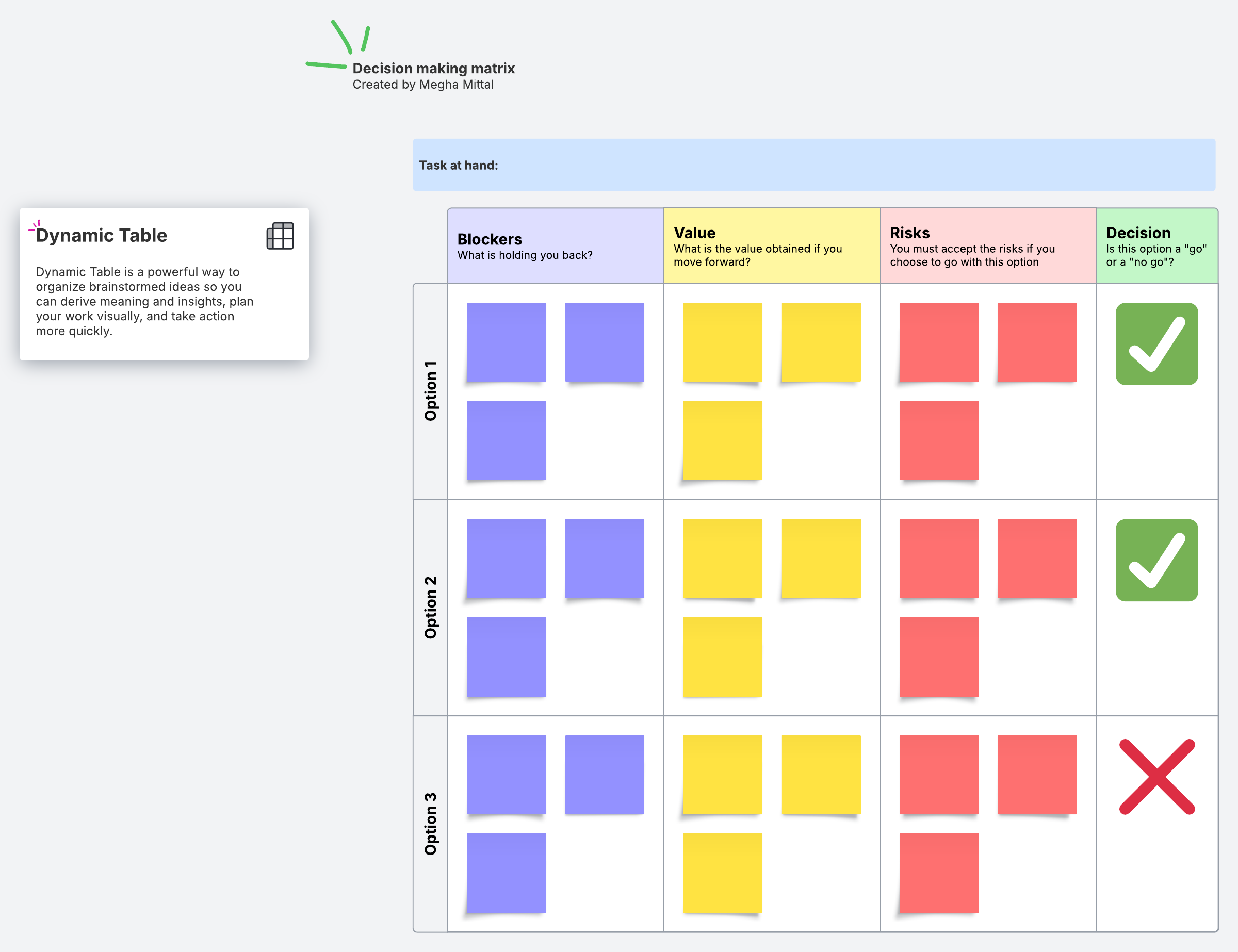
A decision making matrix is, as the name suggests, a visual aid for making decisions. It’s a chart that helps you plot out each option, assign quantitative values to assessment factors, and finally, generate an overall score for each option.
It sounds simple—and it is—but don’t let that fool you. Decision making matrices can help you evaluate your options from a number of angles. Rather than relying on subjective factors—or your “gut”—you can look systematically and logically at the most important factors in the decision making process.
At the end of the process, you’ll have labeled each option either “go” or “no go.” While these labels aren’t necessarily perfect, they’re a great resource as you rank and prioritize your options and, eventually, make a decision.
When to use and what benefits you’ll gain
A decision making matrix will serve you best when you have to evaluate a number of options, each of which has concrete, quantifiable factors that you can evaluate. So if your decision is a matter of taste—which do you like better—skip the matrix.
Despite the name, decision making matrices aren’t only used for making decisions. Sometimes we make decisions and then, after the fact, we have to justify them. Because a decision making matrix helps you assess the value of each option, they can help you evaluate (and support) decisions you’ve already made.
The benefits of a decision making matrix are pretty straightforward: This visual is an easy way to assess the various benefits and drawbacks of a variety of options. Juggling and comparing all of that info can be a difficult task—a matrix gives you the framework you need to systematically consider each factor.
How to use a decision making matrix
If there’s one thing you should know about decision making matrices, it’s that anyone can use them. (And the process gets even easier when you use a decision making matrix template!) To create a decision making matrix, follow these simple steps:
- Draw a grid.
- Identify the task at hand. What are you trying to decide/accomplish?
- Identify your options. What routes can you take to accomplish your task? List them across the top of your grid.
- Identify blockers. Consider each option. What might hold you back or slow you down if you take that route? List these under each option.
- Identify the value of each option. Why go with this option? What does it bring to the table? List these under each option.
- Assess risks. What risks might each route pose? List these under each option.
- Review. Look back at the blockers, value, and risks you identified for each option. Based on that information, label each one a “go” or “no go.”
- Select the best option. Consider each option labeled “go”—these are your best options. Choose one and move forward with it to accomplish your task.
Want to skip the setup and get straight into the decision making process? Try the free decision making matrix template from Lucidspark!

Megha Mittal
Technology Enthusiast